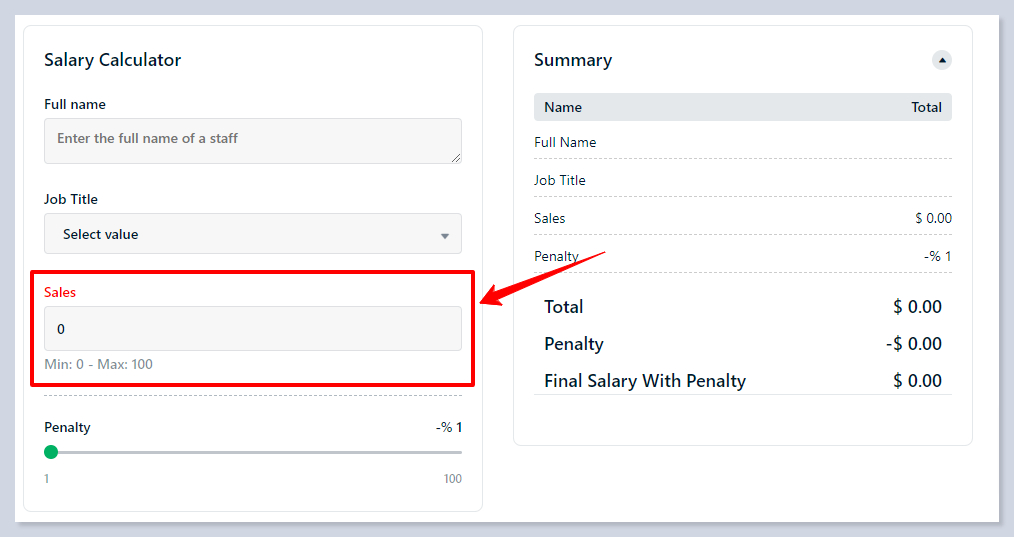
> For the complete documentation index, see [llms.txt](https://docs.stylemixthemes.com/llms.txt). Markdown versions of documentation pages are available by appending `.md` to page URLs; this page is available as [Markdown](https://docs.stylemixthemes.com/cost-calculator-builder/plugin-features/additional-classes.md).
# Additional Classes
The **Additional Classes** setting in the Cost Calculator Builder allows users to customize the appearance of elements by adding **CSS classes.** This feature provides flexibility for users to style elements according to their website’s design.
What Are CSS Classes?
**CSS (Cascading Style Sheets)** classes are used to apply specific styles to HTML elements. By assigning a CSS class to an element, you can control its appearance, such as its color, size, or position, using the class name in your CSS stylesheet.
Each element within the Cost Calculator Builder has a field labeled **Additional Classes in its settings**. Users can input the names of their custom CSS classes into this field to apply specific styles to those elements.
{% hint style="warning" %}
But these classes should be defined in your WordPress beforehand.
{% endhint %}
## How to define Additional Classes on WordPress?
1. Follow **WordPress Dashboard > Appearence > Themes** and click on **Customize**:
2. Open **Additional CSS** tab:
3. Define your CSS classes to the designated area and Publish them:
Here is the example of the CSS classes that hides buttons and changes the color of the title
```css
.custom-style-for-quantity .calc-item__title span {
color: red;
}
.custom-style-for-quantity .input-number-counter {
display: none !important;
}
```
## Adding Additional CSS in Cost Calculator
As an example let's add the custom CSS class to some quantity field.
1. Open the settings of the quantity field, enter the name of the CSS class without dot (`.`) beginning:
{% hint style="info" %}
If you want to add **multiple** CSS classes, separate them with **space!**
{% endhint %}
Two CSS classes
2. Here is the result of our CSS:
{% tabs %}
{% tab title="BEFORE" %}
Title black, up-down buttons visible
{% endtab %}
{% tab title="AFTER" %}
Title red, up-down buttons hidden
{% endtab %}
{% endtabs %}
You can check the CSS classes via Developer Tools on your browser:
---
# Agent Instructions
This documentation is published with GitBook. GitBook is the documentation platform designed so that both humans and AI agents can read, navigate, and reason over technical content effectively. Learn more at gitbook.com.
## Querying This Documentation
If you need additional information that is not directly available in this page, you can query the documentation by asking a question.
Perform an HTTP GET request on the following URL with the `ask` and `goal` query parameters:
```
GET https://docs.stylemixthemes.com/cost-calculator-builder/plugin-features/additional-classes.md?ask=&goal=
```
`ask` is the immediate question: it should be specific, self-contained, and written in natural language.
`goal` is what the user is ultimately trying to achieve, the reason they need the answer. Sharing it helps GitBook give you a better, more relevant answer. A goal is most helpful when it describes the outcome the user wants rather than restating the question. For example, with `ask=how do I create an API token`, a goal like `automate deployments from our CI pipeline` lets GitBook tailor the answer to that use case.
The response will contain a direct answer to the question and relevant excerpts and sources from the documentation.
Use this mechanism when the answer is not explicitly present in the current page, you need clarification or additional context, or you want to retrieve related documentation sections.