> For the complete documentation index, see [llms.txt](https://docs.stylemixthemes.com/llms.txt). Markdown versions of documentation pages are available by appending `.md` to page URLs; this page is available as [Markdown](https://docs.stylemixthemes.com/masterstudy-theme-documentation/masterstudy-lms-pro-addons/certificate-builder.md).
# Certificate Builder
The Certificate Builder addon lets you make and design your own certificates. These are given to students when they finish their course.
### Certificate Builder
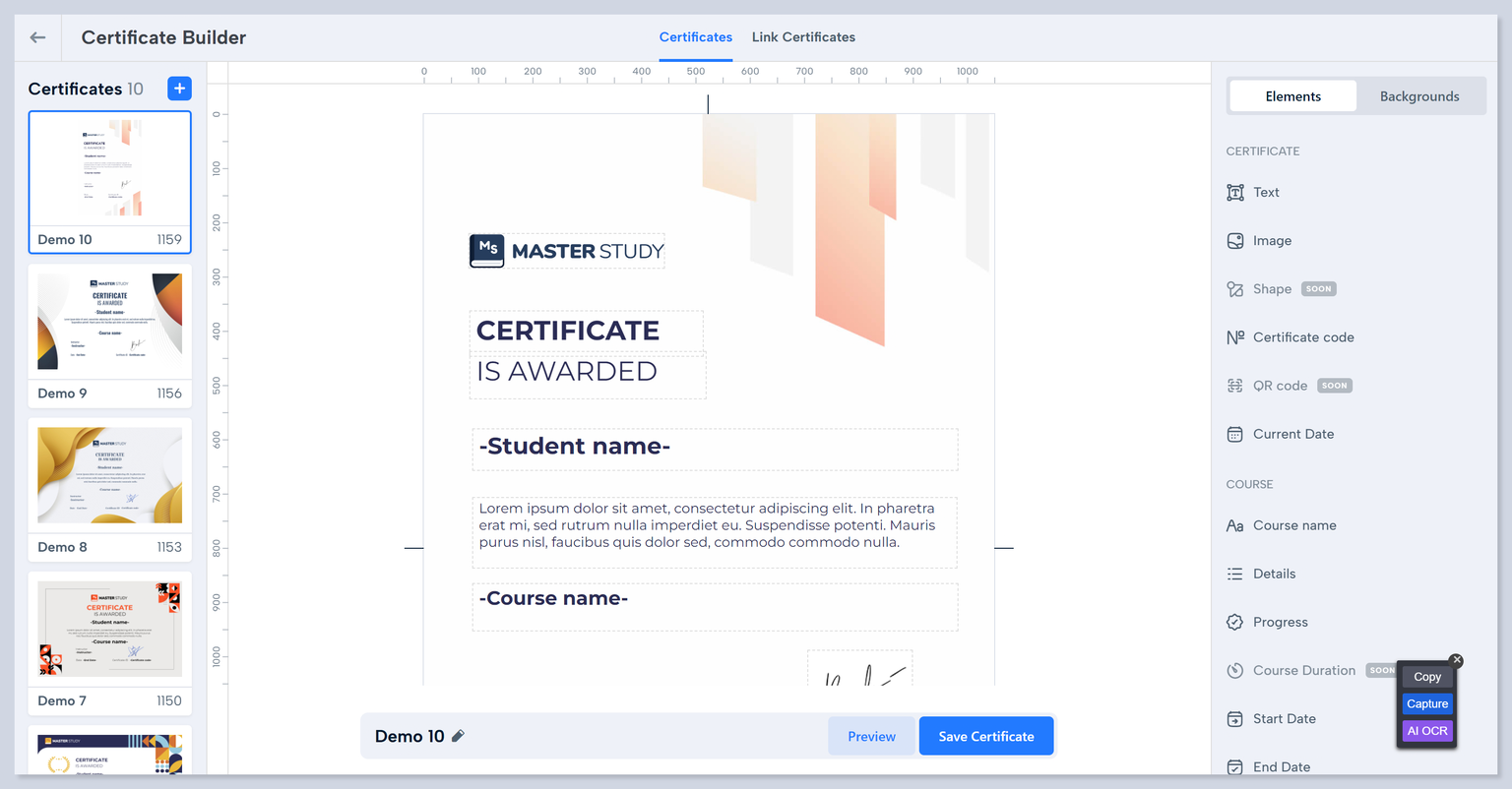
After clicking on the Settings Icon you will be redirected to the Certificate builder.
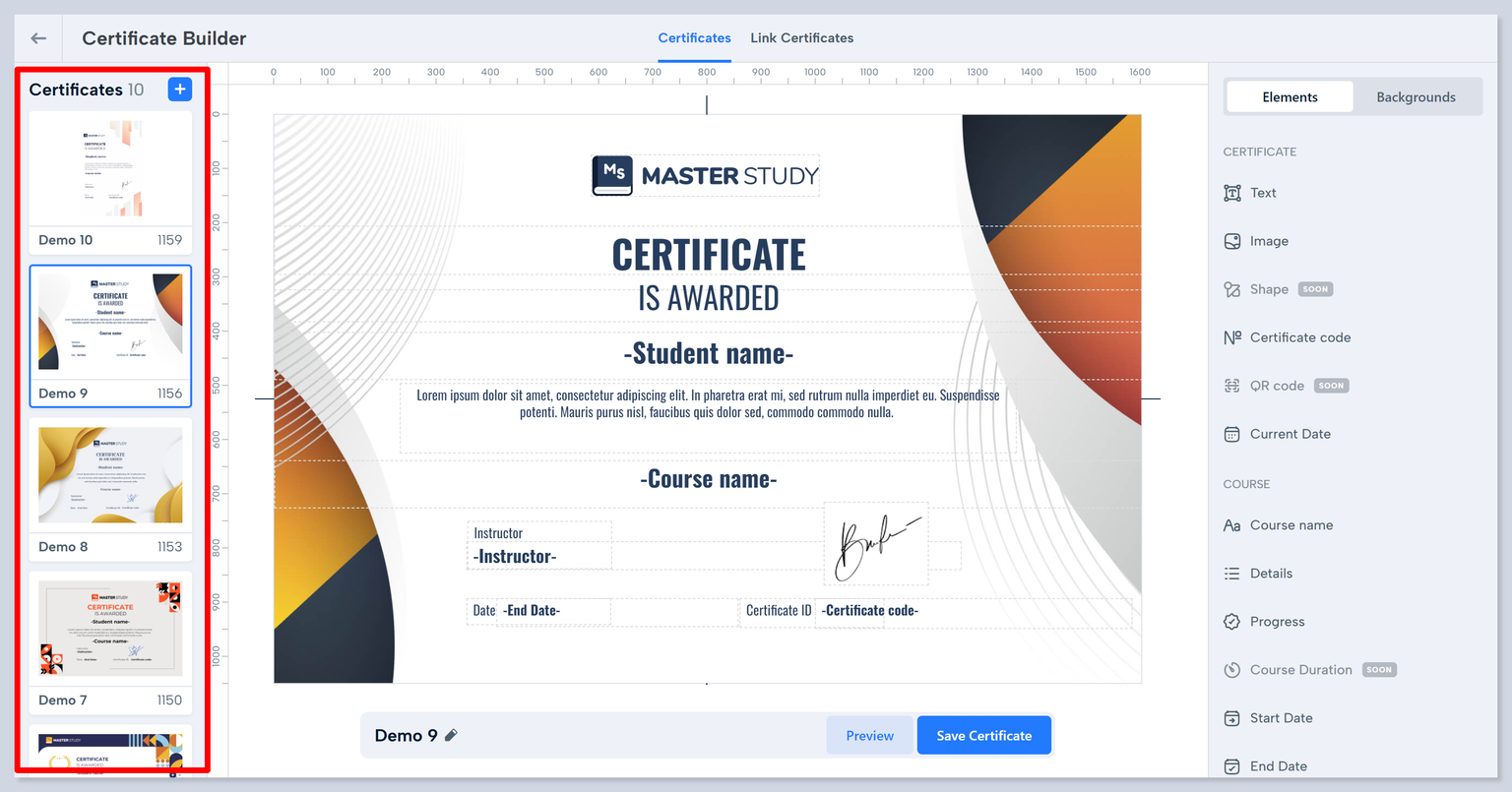
On the left side, you can see a dashboard of ready templates you can choose from:
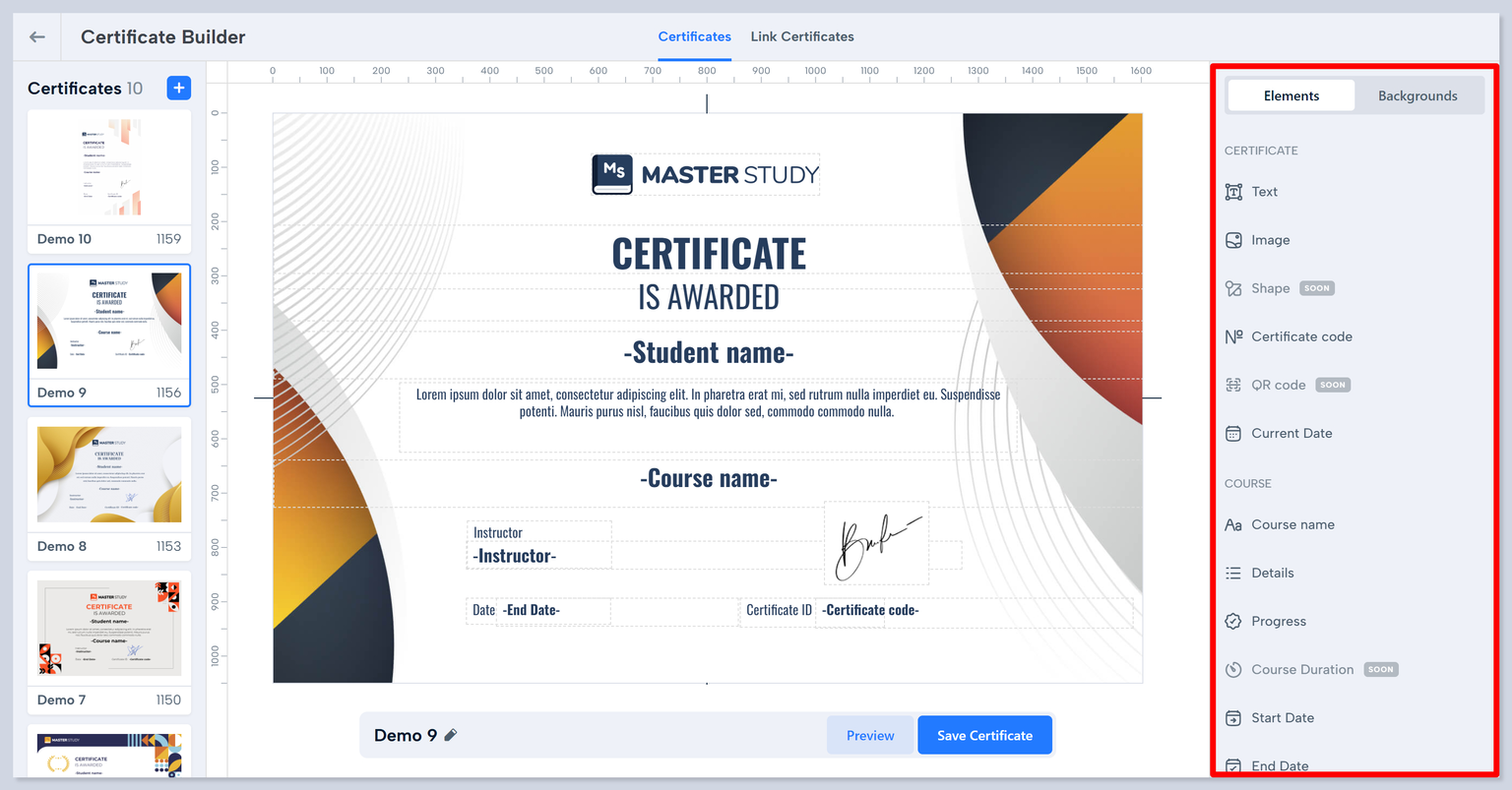
On the right side, there is a sidebar with elements and backgrounds to be added. These elements are available in the Elements section:
* Text
* Image
* Certificate code
* Date (Current, Start, End)
* Course name
* Details
* Progress
* Student name
* Student code
* Instructor name
* Co-Instructor name
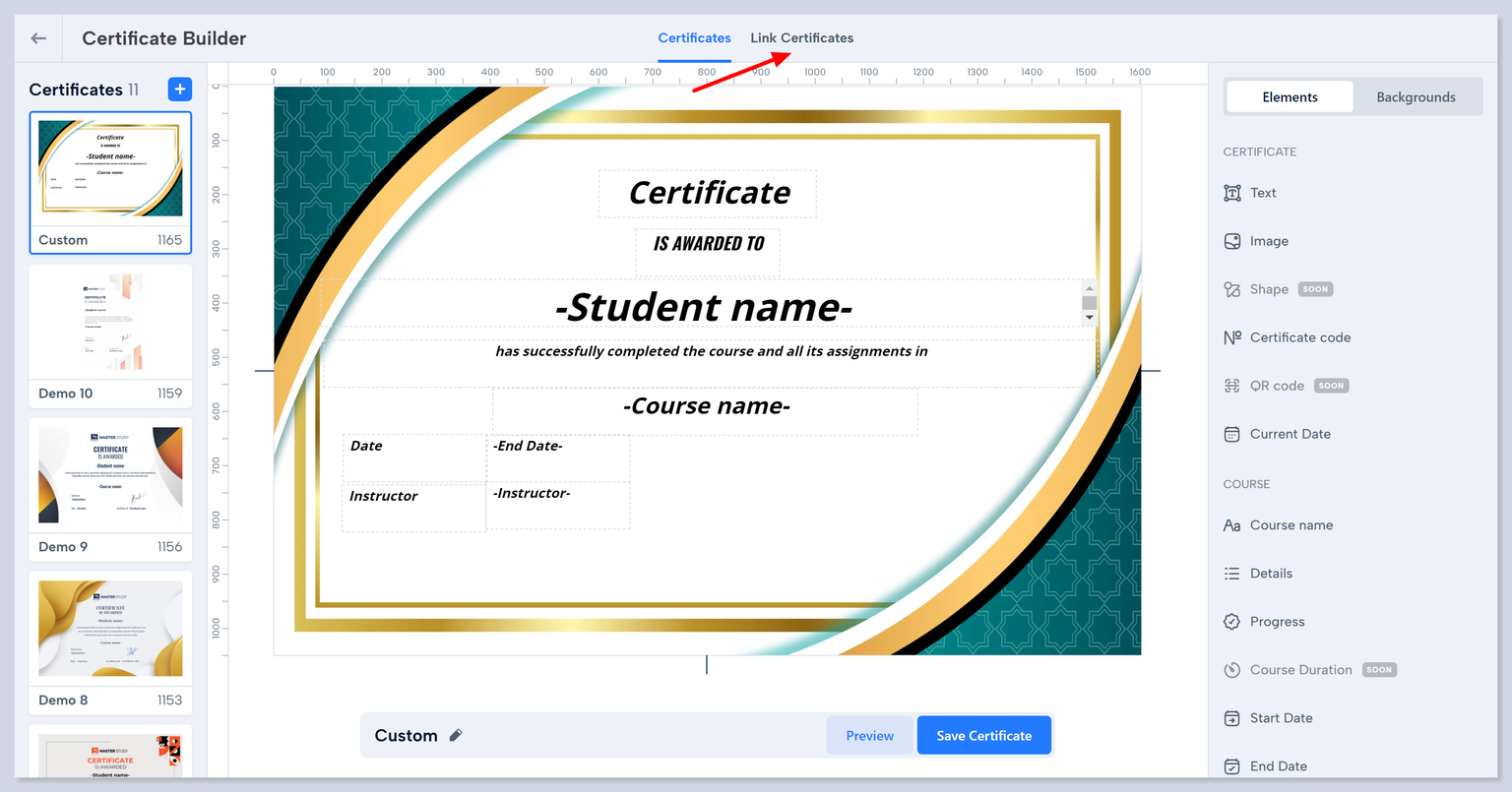
In the Certificate Builder, there is another tab **Link Certificates**, where you can assign your certificates to certain categories and courses.
### Creating a Certificate
1. Go to the addon page and click on the Certificate addon settings.
2. You will open the Certificate Builder.
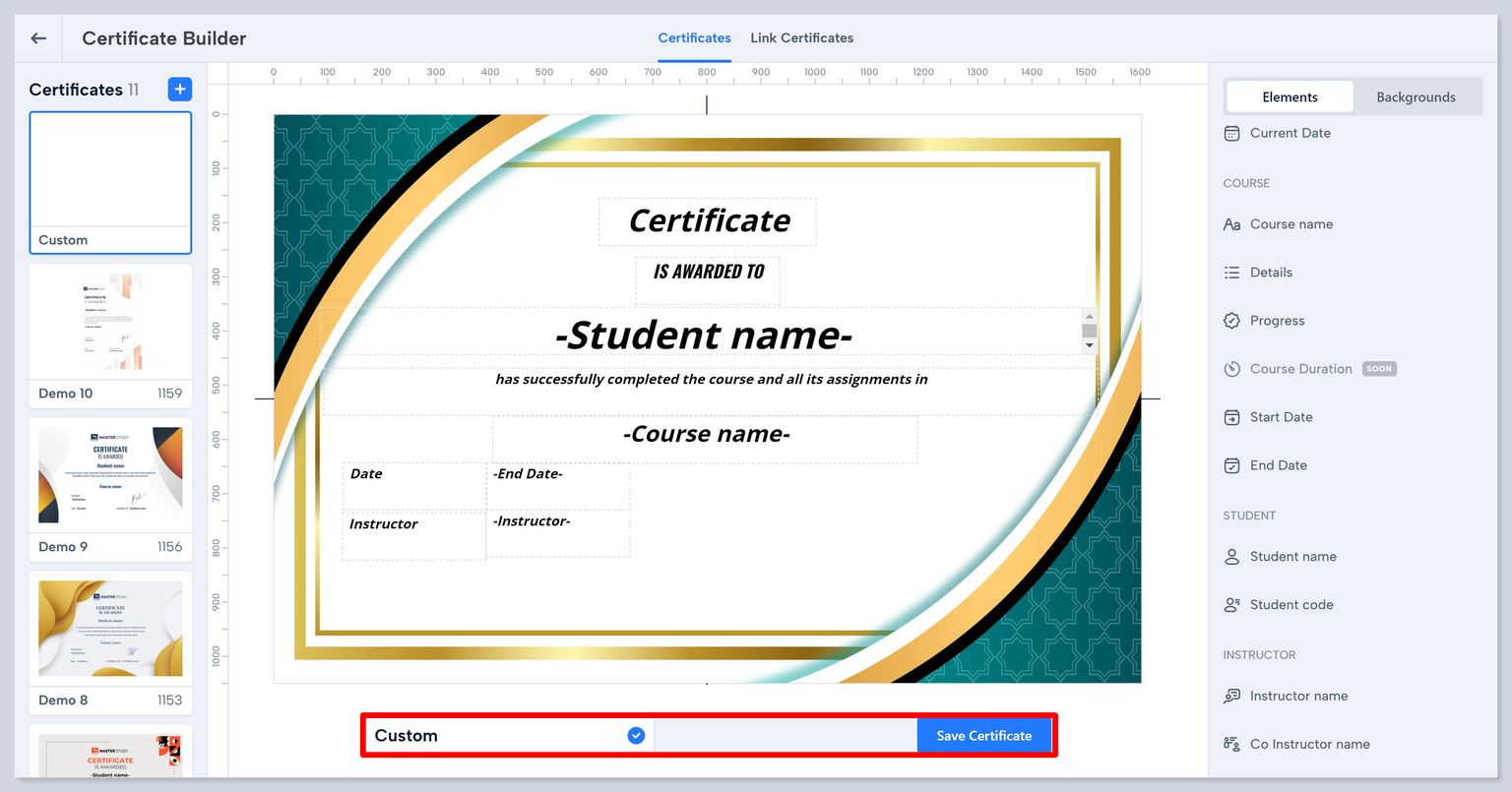
3. You can use a premade template, select one from the left side of the builder and customize it according to your branding requirements.
4. To create a new certificate, click on the + sign.
5. Then choose the certificate's orientation: horizontal or vertical.
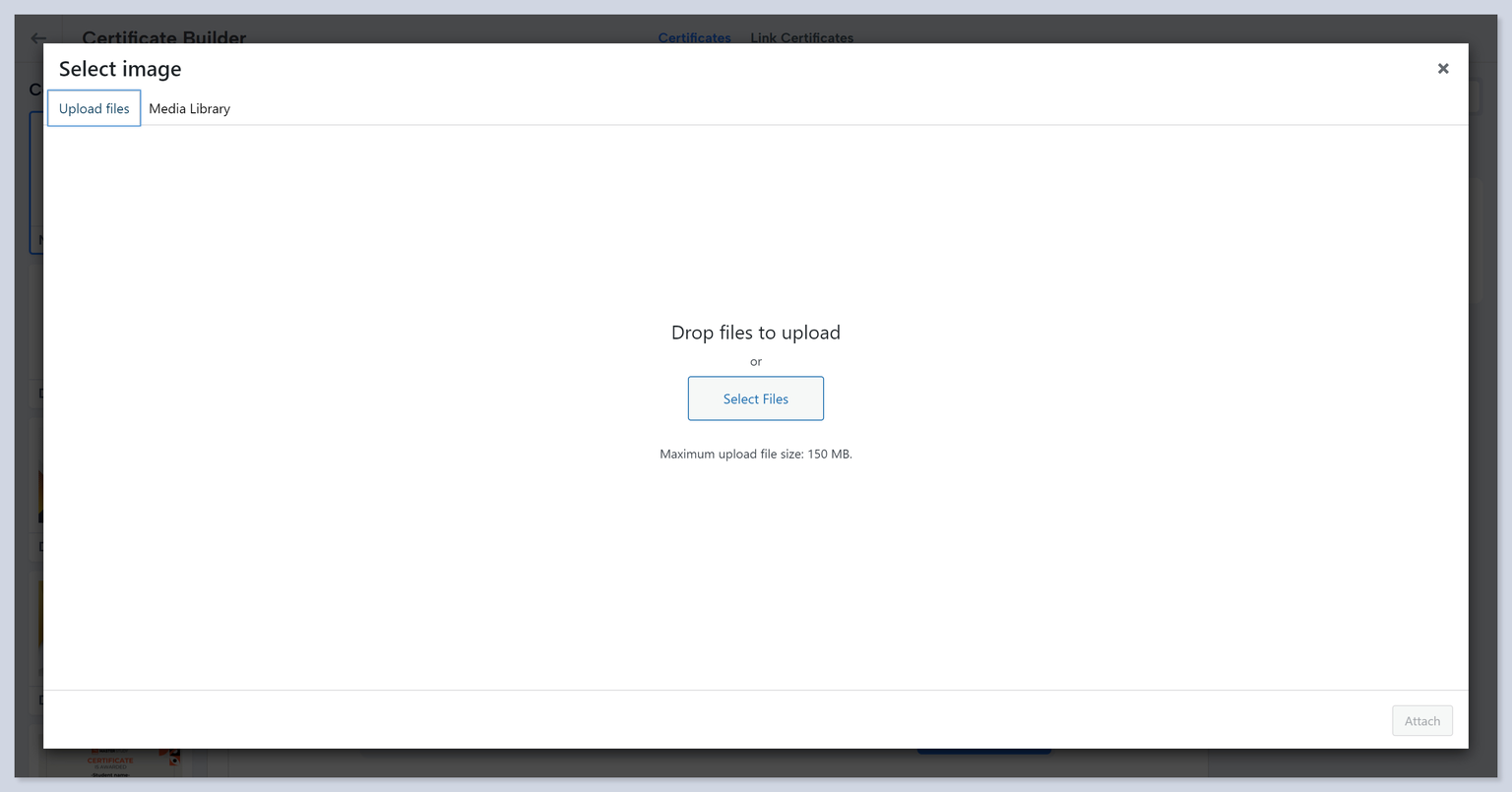
6. You can add a background by clicking on "Select image".
7. In the open window, you can upload a background from your files.
8. After adding a background, go to the Elements section.
9. Click on the element and place these elements as desired within the Certificate builder.
10. You can further personalize the element by adjusting the font, size, color and alignment, and applying styling options like bold or italic.
{% hint style="success" %}
**Certificate Builder Elements** are powered with hundreds of **Google Fonts** font families, enabling you to build certificates in **any** font **style, family,** and **language.**
{% endhint %}
Google Fonts as an example of Text Field
11. Add other elements to create your desired certificate.
12. Name your template and click on the save button at the bottom of the page.
12. After saving, use the preview button to view your newly created certificate.
This is how it will look for your students after downloading the certificate:
## Certificate Builder for Instructors
Instructors can also create certificates and assign them to their courses. First, make sure that you have enabled **Allow Instructors to Create Certificates** in the **MS LMS Settings**:
Instructors can access the feature by following their dashboard:
On this page, the list of the previously created certificates of the instructors will be displayed. Instructors can create new certificates or modify the existing ones from here.
Instructor Dashboard > Certificates
{% hint style="info" %}
Certificates of other users are not accessible to edit to each other. However, they can use the certificates on your website in their courses.
{% endhint %}
Instructors can link the certificates to their courses from the respective tab of the Course Builder:
Course Builder > Settings > Certificates
## Linking Certificates
Certificates can be linked to the courses in 3 different ways:
* [**Default Certificate**](#linking-a-default-certificate) - one certificate template will be chosen and applied to all courses globally.
* [**Category Certificate**](#linking-a-certificate-to-categories) - different certificates can be linked to specific course categories. It ignores the Default Certificate. For example, you can design a modern certificate and assign it to the Software Engineering course category. All courses in this category will be accompanied by a certificate of completion.
* [**Certificates for Courses**](#linking-a-certificate-to-courses) **(individual)** - you can assign a template to one course specifically using Course Builder as well. It ignores the **Default Certificate** and **Category Certificate**.
{% hint style="info" %}
Additionally, you can turn off **Issue a certificate upon completion of the course** setting on [Course Builder,](#user-content-fn-1)[^1] and students will not get a certificate after completion.
{% endhint %}
To link a certificate to courses, go to the Link Certificate.
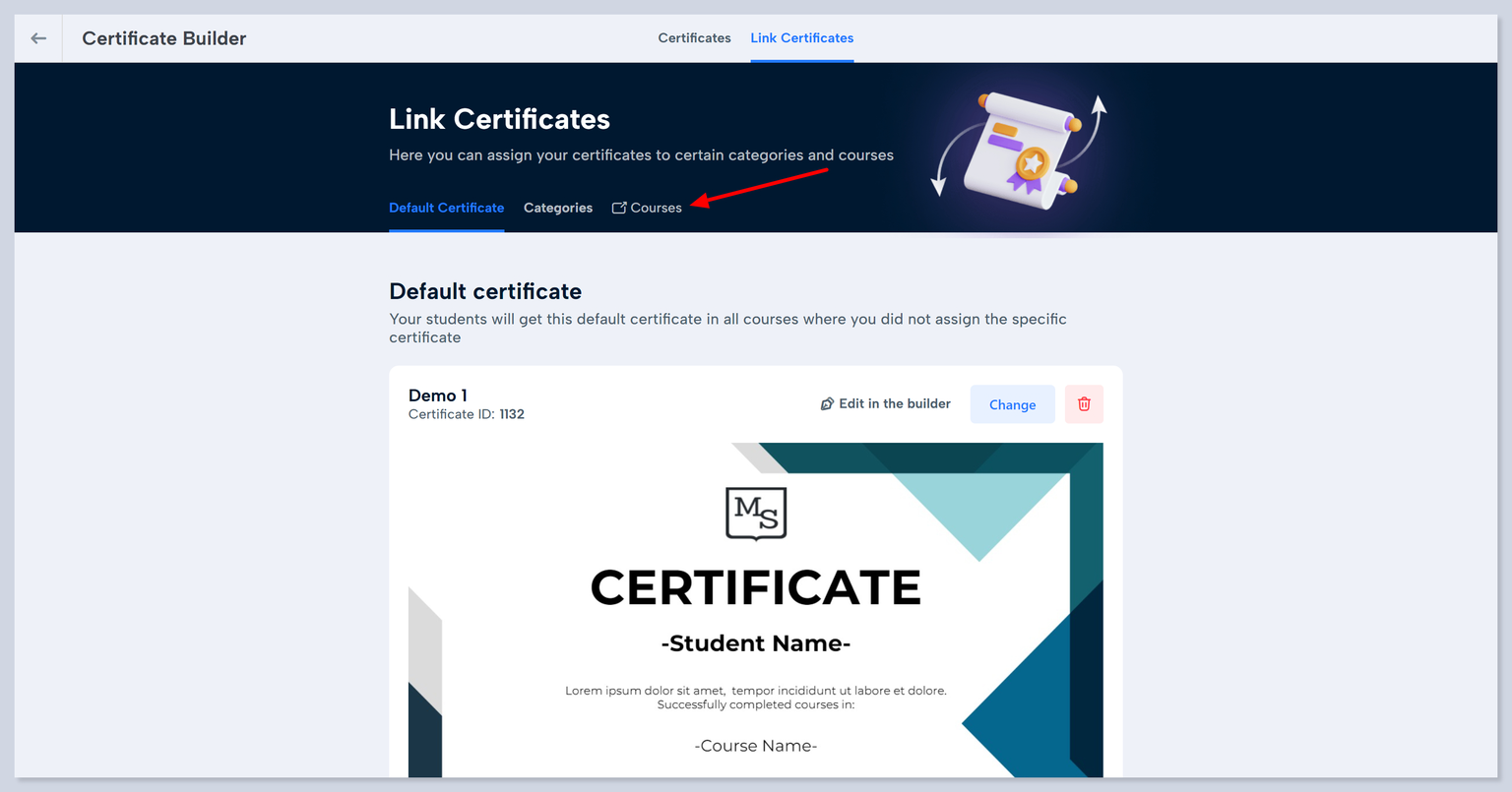
Next, you'll see three tabs where you can assign a default certificate, one to the categories or courses.
### **Linking a Default Certificate**
To assign another default certificate, click Change.
Choose a template you want to make default and save the changes.
You have changed the default certificate. Your students will get this default certificate in courses where you didn't specify the certificate.
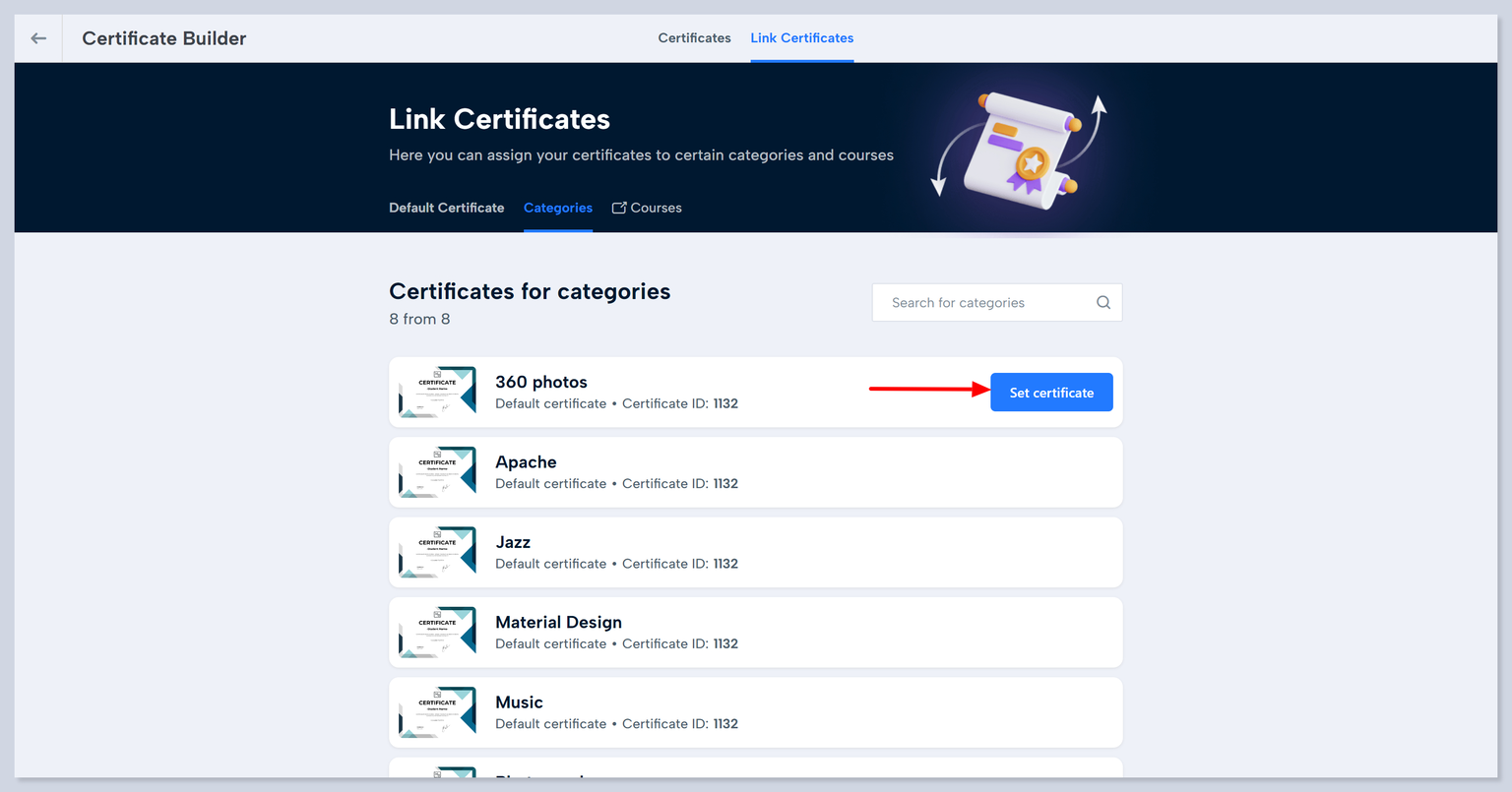
### **Linking a Certificate to Categories**
In the Categories tab, click Set certificate on the category you want to set your own certificate.
From the certificate choose a template and save changes.
So, you have set a certificate to the specific course and it can be unlinked and changed.
### **Linking a Certificate to Courses**
To link a certificate to a specific course, go to the Courses tab.
You'll be redirected to the page with courses.
Choose the course you want to add a certificate and click on Edit with Course Builder.
Go to the Settings in the Course Builder.
Head over to the Certificate section.
Choose a template from the list.
{% hint style="info" %}
The **Default by System** option applies the certificate set globally to the course.
***
**Issue a certificate upon completion of the course -** if you disable this setting, students will not get the certificate after completing the course.
{% endhint %}
Save changes. Students of the course will get this certificate after completion
### Page Builder
If you are using the WPBakery, you can use a special element. Edit the page you want to insert a certificate checker to, click **Add element,** and select the **STM Certificate checker**.

Enter the title.

For **Elementor** there is also an element for certificate checker. Edit the page with Elementor. Under the **Elements tab** search for the **Certificate checker** and drag the widget to the working space. In the **Content** settings enter the title.


Users will need to use the code of a certificate in order to verify it.

Just paste the code into the field and click **Check Code.**

[^1]: Course Builder > Settings > Certificate
---
# Agent Instructions
This documentation is published with GitBook. GitBook is the documentation platform designed so that both humans and AI agents can read, navigate, and reason over technical content effectively. Learn more at gitbook.com.
## Querying This Documentation
If you need additional information that is not directly available in this page, you can query the documentation by asking a question.
Perform an HTTP GET request on the following URL with the `ask` and `goal` query parameters:
```
GET https://docs.stylemixthemes.com/masterstudy-theme-documentation/masterstudy-lms-pro-addons/certificate-builder.md?ask=&goal=
```
`ask` is the immediate question: it should be specific, self-contained, and written in natural language.
`goal` is what the user is ultimately trying to achieve, the reason they need the answer. Sharing it helps GitBook give you a better, more relevant answer. A goal is most helpful when it describes the outcome the user wants rather than restating the question. For example, with `ask=how do I create an API token`, a goal like `automate deployments from our CI pipeline` lets GitBook tailor the answer to that use case.
The response will contain a direct answer to the question and relevant excerpts and sources from the documentation.
Use this mechanism when the answer is not explicitly present in the current page, you need clarification or additional context, or you want to retrieve related documentation sections.